Worldwide Business Search Engine

Loading
Showing posts with label Charlie Munger. Show all posts

Tuesday, April 26, 2011

US Home Prices Drop Again


But is that bad?

In a story on CNBC, Home Prices fall for 8th straight month, David Blitzer, chairman of the Index Committee at S&P Indices, is quoted as saying, "There is very little, if any, good news about housing. Prices continue to weaken, trends in sales and construction are disappointing." When I read the same statement, I thought it was good news. Why the difference?

Everyone uses mental models in their daily life - whether they are aware of it or not. A mental model is a way of thinking, usually learned from the culture one grows up in, but often changed by education. A clear example is that in the West, most people believe that the mind/soul and body are separate. University educated individuals tend to use the scientific method to discover things, rather than logic or meditation.

Fictional character Sherlock Holmes famously uses “deductive reasoning” to solve crimes. Deductive reasoning is eliminating anything that must be false in order to find the last remaining item, which must be the truth. It is said that Sherlock Holme's author, Sir Arthur Conan Doyle, learned this technique from his university medical professor, who used it to diagnose patients.

Warren Buffett’s business partner, Charlie Munger, commonly uses “inversion.” Inversion is looking at every problem from the opposite direction from the normal one: for example, instead of asking, “How can we improve customer service?” Munger might ask, “How can we have terrible customer service?” The opposite of that answer is the way to have great customer service.

In Iraq, US soldiers and politicians often become annoyed because the Iraqis do not think of the relationship between cause-and-effect the same way we do. That is, they view the relationship between cause and effect as weak. If Iraqis take a day off to play cricket instead of building a new water pipeline, they don’t necessarily see the connection to having no clean water later that month. This difference in thinking is so frustrating for American troops that there is a whole series of military intelligence "lessons learned" documents devoted to it.

Now to examine David Blitzer’s comment: "There is very little, if any, good news about housing. Prices continue to weaken, trends in sales and construction are disappointing." Under normal circumstances, this statement would be perfectly logical. In a normal economic cycle, all these things indicate a weakening economy. David is inferring that low sales, low construction, and falling prices are bad – the traditional economist’s view. But is it truly bad? Or is David using a “fossilized mental model” – one that is not relevant for the situation?

The US had a housing bubble: that means there were unrealistic prices, oversupply, and sales to people who were not qualified. The remedy for a housing recovery is therefore lower prices, no new construction (until excess inventory is gone), and low new home sales (since foreclosures will be sold first). In other words, today's statistical weakness is exactly what the housing market needs to recover. At this point, strength in any of these numbers would be negative.

The banks can only release foreclosures onto the market at the same rate as the market is ready to absorb them. Since the banks control the flow of this inventory, new home sales and price stats are meaningless: any increase in market strength will be met by the release of foreclosures to match.

Prices are low enough that when the housing market does return, it will do so with a roar. Just like the bubble on the upside, the longer US housing numbers stay weak the more sudden and dramatic the recovery will seem.

Several months ago, I wrote that it was a good time to buy US real estate. Since then, in most cities home prices have fallen by about 3%. I do not apologize for this imperfection.

No one knows exactly when the market will recover, yet one thing is certain – buying quality real estate at a time of low interest rates and low prices will never prove to be a bad investment. Don’t try to catch the exact bottom.

____

"Don't try to buy at the bottom and sell at the top. This can't be done - except by liars."

Bernard Baruch

____

Monday, August 30, 2010

Happy Birthday, Warren


The richest man in America turns 80 today.

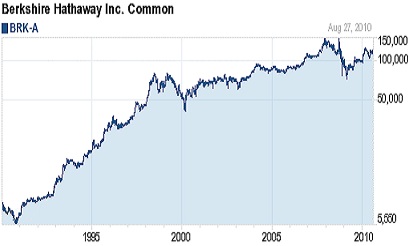
In his time, Warren Buffett has positively affected the lives of thousands of investors, including those who became wealthy employing his techniques (based on the work of Benjamin Graham), as well as those who simply bought his stock (BRK.A & BRK.B).


In addition to being a great investor, people connect with Buffett because he just doesn’t act like a typical billionaire. He is frequently spotted chatting with shareholders, enjoying T-bones at the local steakhouse, or playing bridge. Several years ago, a shareholder was surprised to see Buffett and his friend, Bill Gates, walking around a McDonalds restaurant in China, looking for a table.

In recent years, Buffett has developed an almost saintly reputation, which is not entirely accurate. He has always had a complicated social life that includes “female friends.” He unapologetically buys stocks of military hardware developers, tobacco companies and breweries if he considers them to be of good value. He takes advantage of the suffering of large companies (like all good value investors) by rescuing them in return for convertible preferred shares paying high rates of interest.

Despite his arguable flaws, however, most agree that his positive attributes - both personal and business - vastly outweigh them. While most billionaires are hated simply because they are billionaires, Warren Buffett’s likability and charm have actually grown with his riches.

Honesty and humility go a long way.

Rationality adds still more.
____


____

”Testing…one million, two million, three million.”

Warren Buffett, at the microphone of the University of Florida
____

Sunday, June 27, 2010

Barack Obama - Enemy of Business?

The same people who were clamouring for financial reform during the height of the crisis now appear to be taking a "if it's not broken don’t fix it" approach. Having seen their stocks go up since the lows of 2008, fear of change has taken hold. How can we be considering financial reform when talk of it makes markets drop? Don't the markets "know everything?"

Many conservatives have branded financial reform or regulation as "socialist" or "communist," making the ridiculous conclusion that since the highly-regulated communist structure didn't work, a complete lack of regulation must be best. Such short-term and narrow minded thinking is bad for the nation. Financial reform is necessary - and has been a long time coming:
__

"If we bail out this one (Penn Square Bank)...then the markets will know that, no matter what risks they take, the government will bail them out. Eventually, its going to lead down the road to nationalization of the banking system."

William Isaac, FDIC chairman, 1982
__

"If this sounds like a warning, it is."

Gerald Corrigan, President of the Federal Reserve Bank of New York, telling bankers that the over-the-counter (OTC) market seemed to be expanding without adequate controls, 1992
__

"Improved 'transparency' - a favorite remedy of politicians, commentators and financial regulators for averting future train wrecks – won't cure the problems that derivatives pose. I know of no reporting mechanism that would come close to describing and measuring the risks in a huge and complex portfolio of derivatives."

Warren Buffet, Berkshire Hathaway 2008 Annual Report
__

"A key question: Should we opt for even more pain now to gain a better future? For instance, should we create new controls to stamp out much sin and folly and thus dampen future booms? The answer is yes. Sensible reform cannot avoid causing significant pain, which is worth enduring to gain extra safety and more exemplary conduct."

Charles T. Munger, 2009, in the Washington Post
__

"A clear lesson of this crisis is that any strategy that relies on market discipline to compensate for weak regulation and then leaves it to the government to clean up the mess is a strategy for disaster."

Timothy Geithner, Secretary of the Treasury, 2010 in the Washington Post
__

"It is simply unacceptable to walk away from this recession without fixing the system's basic flaws that helped to create it."

Timothy Geithner, Secretary of the Treasury, 2010, in the Washington Post
__

"A clear lesson from the events of the past few years--and a recommendation in the report with which we strongly agree--is that the government must not be forced to choose between the unattractive alternatives of bailing out a systemically important firm or having it fail in a disorderly and disruptive manner. The government instead must have the tools to resolve a failing firm in a manner that preserves market discipline--by ensuring that shareholders and creditors incur losses and that culpable managers are replaced--while at the same time cushioning the broader financial system from the possibly destabilizing effects of the firm's collapse… The financial reform legislation in both the House and the Senate would provide for such a resolution regime."

Ben Bernanke, Chairman of the Federal Reserve, 2010, Fed Speech
__

In my estimation, one of the reasons people hate Obama is because he is forward thinking and logical, and therefore does things that voters hate (a rare combination in politics). In doing what's necessary, he successfully manages to piss off every possible segment of his support base. He makes poor people get health insurance coverage, even if they don't want it. He institutes financial reform at a time when the market is recovering and when each word from his mouth causes the market to drop. His logic, rather than his strict adherence to political philosophy, makes him "difficult" and "impossible to predict." Personally, I like the fact that Obama ignores popular opinion and just gets things done. No doubt he will be a one-term president.

Enemy of Business: no.
Enemy of dangerous, unregulated, pre-1929 style business: yes.
____

"Issues are never simple. One thing I'm proud of is that very rarely will you hear me simplify the issues."
Barack Obama

Sunday, May 23, 2010

Cognitive Dissonance

INVESTOR PSYCHOLOGY


Improve your investing by improving your way of thinking.


"Cognitive dissonance" is the name for anxiety caused by disconcerting thought processes. That is, when people are faced with facts that make them uncomfortable, they tend to ignore these facts, literally to the point of self-denial.

Cognitive dissonance is the reason why a mother won’t accept that her son is dead, even when the police are standing in the doorway telling her. Cognitive dissonance is the reason why a husband with an unfaithful wife will always be the last to know. It is why those in debt do not open their mail. It is why Al Capone thought he was a good person because he donated to charity. And, it is why Americans who wished to buy a home in 2006 (or already had one) insisted that there was no housing bubble, despite all evidence to the contrary.

It is a natural thing for people to seek confirmation of their existing beliefs. Finding facts to prove you are right is both satisfying and comfortable. This is why conservative Republicans watch Fox News, anti-globalization protesters read Noam Chomsky, and why environmental activists seldom read the Oil and Gas Journal. But in order to be a truly effective thinker, one must embrace cognitive dissonance by intentionally seeking disconfirming evidence. For many great thinkers, including investors Charlie Munger and George Soros, the best technique for embracing cognitive dissonance is a simple one known as “Inversion.”

Inversion states that in order to prove that something is true, you should try to prove it false; that is, for any strong belief that you have, regularly search for evidence you might be wrong. If you wish to buy a stock, for example, you would include a search for reasons not to buy it. You would read not just the glowing press releases about the company, but also seek out all negative facts about the company, and judge these facts without emotion. Only after finding no significant reasons not to buy the stock would you actually buy it.

Cognitive dissonance is not easy to overcome. You will be fighting natural human emotion every step of the way. Despite a lifetime of working on it, I have fallen prey at least twice, and will no doubt do so again. But by making a habit of questioning your own judgements and attempting to prove your own beliefs false, you will become a stronger and more reliable investor (and possibly a better person). Soon, you will find that your mental discomfort becomes a source of pride and pleasure, not to mention lucrative.
____

“Faced with the choice between changing one’s mind and proving there is no need to do so, almost everyone gets busy on the proof.”
John Kenneth Galbraith