Worldwide Business Search Engine

Loading
Showing posts with label berkshire hathaway. Show all posts

Saturday, February 11, 2012

Share Buybacks - Good or Bad?


A recent article from Canada’s Globe and Mail ("Share Buybacks: The wrong way to reward shareholders") suggests that stock buybacks are - as a rule - useless.

The Globe article states that after a buyback program is announced a company's stock price usually declines anyway; that is, the buyback typically signifies a peak, and does not add any value to shareholders.  But is this correct?  How can buying back shares not add value to shareholders?

The Globe's simple look at the statistics ignores the rationale for doing buybacks. In fact, there are good stock buybacks and bad ones, and management’s reasoning makes all the difference.

Share buybacks can be the best way to reward shareholders. The fact that the market doesn't immediately recognize this and boost the stock price is irrelevant.

When a company's shares are trading at close to or below book value and at low P/Es, why would the company issue dividends or make acquisitions? Buying the stock of an underpriced company (their own) is the best choice. Every share bought back by the company means more earnings for remaining shareholders. For example, if a company has earnings per share of $.50 and you own 100 shares, your personal share of the earnings is $50.00. If the company buys back ¼ of its shares, your personal share of the same earnings is now $62.50. Eventually, more earnings per share = a higher stock price.

On the other hand, if a company's stock is overvalued either in terms of P/E or book value (or both),  then share buybacks are clearly a waste of money: why buy back overpriced shares when the same money could be used to make valuable acquisitions or pay a dividend? In this case, a share buyback doesn't make sense.

When management does a share buyback for the right reasons, people notice.  When Berkshire Hathaway, for example, announced in Sept of 2011 that it would buy back shares, BRK jumped 8% in a single day.

The Globe and Mail article notes that companies typically buy back stock when they are flush with cash but stock prices are high - which is the wrong time to buy back stock. At the moment, however, many companies are flush with cash at a time when their stock prices are low - the perfect time to buy back stock.

Good companies pay extra dividends or make acquisitions only when their stock is overvalued (or at least fairly valued).  When their stock is undervalued, buybacks are the best choice.
____

"When companies purchase their own stock [at a discount to fair value], they often find it easy to get $2 of present value for $1."

Warren Buffett
____

Sunday, January 22, 2012

Berkshire Hathaway's Machine


If you believe recent commentaries, Berkshire Hathaway’s Warren Buffett – once considered one of the greatest investors in the world – is now “too old” for investing and is washed up, tired, and has lost his touch.  The people making these comments have clearly not taken the time to examine Berkshire’s financial statements!

In investing, timing is everything.  An undervalued investment can sometimes take months or years to begin rising in price; and, while waiting, returns will be stagnant.  Berkshire has found a way around this problem.  Berkshire is now so synonymous with safety and stability (and for being a good business partner) that it obtains exclusive deals – unavailable to anyone else - where it is actually paid to wait.

Take, for example, Berkshire’s investment in Bank of America.  BAC’s current share price is $7.07.  Berkshire bought preferred shares of BAC that earn 6%.  With this preferred share deal came warrants to purchase up to 700 million shares of BAC at $7.14 per share, and these warrants don’t expire until 2021.  In other words, any time between now and 2021, Berkshire can purchase BAC shares at $7.14 per share, even if the stock doubles or triples (or more).  While waiting, Berkshire earns 6% on the Preferred shares!

Berkshire has a similar deal with Dow Corporation.  Berkshire currently earns 8.5% on Dow Preferred Shares.  Berkshire can purchase up to 72.6 million shares of Dow at $41.32 per share with no expiry date, except the stipulation that Dow has the option to redeem the preferred shares when the stock attains stable prices of $53.72 or more!  Put more simply, this means that Berkshire will earn 8.5% from its investment in Dow for months or years, and then make at least $12.40 per share ($52.72-$41.32) when the Preferred shares are converted to common shares, for an additional profit of 900 million dollars.

Berkshire Hathaway is an incredible moneymaking machine...especially for those who have the luxury of time, and the patience to wait.

____


"The most important attribute for success in value investing is patience, patience, and more patience.  The majority of investors do not possess this characteristic."

Peter Cundill

____

Tuesday, January 17, 2012

Stocks I Like - Leucadia National Corp


Leucadia National Corporation (stock symbol: LUK) may be the biggest, most successful company you've probably never heard of.

A quick look at Leucadia's website (www.leucadia.com) reveals that this company is different; the homepage looks like it was designed by a high-school student twenty years ago (and maybe it was).  One would never guess that as of Q3 2011, the company had assets in excess of 9 billion dollars, and that in 2010 - Leucadia's last fully reported year - the company had $1.3 billion in revenues.

Virtually everyone these days has heard of Berkshire Hathaway and it's famous value investor, Warren Buffett.  Yet, Leucadia National Corp. has managed to stay under the radar of the average investor: presumably where they want to be.

Like Berkshire Hathaway, Leucadia is a conglomerate, specializing in the purchase of undervalued, under priced assets.  Also like Berkshire, their annual reports are easy to read, honest and straightforward.  Unlike Berkshire, Leucadia loves to buy "turnarounds" - companies with bad management, shoddy business practices, or lack of funding.  It then sticks with these companies - often for years - providing the management expertise and funding required until the moment of fruition.

At present, Leucadia owns investment banks, mines, timber companies, plastics manufacturers, wineries, energy companies, hotels , auto retailers and natural gas drillers.  Leucadia also has a 50% stake in "Berkadia Commercial Mortgage Inc.," a  joint venture with Berkshire Hathaway.

Leucadia frequently carries a massive cash and stock portfolio: as of Q3 2011, $306 million in cash and $811 million in investments.  Due to this large stock portfolio (and the fact that Leucadia purposely invests in money-losing companies), the company's income tends to swing wildly; despite this, the company has averaged a stunning equity growth rate of 20.2% annually since 1978.

Knowing that Leucadia's investors are value investors, you can be fairly certain that their current investments are drastically undervalued.

Leucadia is currently trading at $25.45 per share.

____


"We quickly changed the name from Goober Drilling to Keen Energy Services."

Ian Cumming and Joseph Steinberg of Leucadia National Corp, regarding their 2009 purchase of Goober Drilling of Stillwater, Oklahoma.

____


Disclosure

Do not buy stocks, or take this or any other financial advice without doing your own analysis; including, but not limited to: reviewing business models, financial statements, management style and philosophy, recent developments, market macroeconomic analysis, and chart analysis. If you do not know how to do these things, you shouldn't be buying stocks in the first place. Seek the advice of professionals, as appropriate.

____


Saturday, April 2, 2011

The Berkshire Soap Opera

Earlier this week, Warren Buffett’s Berkshire Hathaway issued a surprising press release: one of their longstanding top executives, David Sokol, had resigned.

Here’s the gist of the story… Warren Buffett and his partner Charlie Munger make all the major acquisition decisions for Berkshire Hathaway. Executive David Sokol recommended to Buffett a company called “Lubrizol,” mentioning at the time that he owned some shares of it himself. Buffett was not particularly impressed with the idea of acquiring Lubrizol. About a week later, David Sokol spoke with the CEO of Lubrizol, and based on that conversation spoke with Buffett again, further recommending it as a good purchase. As a result, Buffett changed his mind and purchased Lubrizol, sending its stock price soaring.


What David Sokol had neglected to point out was that when he said he owned, “some shares” of Lubrizol, he actually meant 10 million dollars’ worth (more than 96 thousand shares). In just one day after the Berkshire purchase announcement, Lubrizol stock jumped from $104.50 to $133.80, earning David Sokol a cool 2.8 million dollars.


Was what David Sokol did illegal? Probably not. Was it unethical? Somewhat. Was it honest and open? Not at all.


On July 26th, 2010, Buffett wrote a letter to all Berkshire Hathaway managers (including Sokol), saying that reputation and honesty are of paramount importance to Berkshire’s business. For example, Buffett wrote: “We must continue to measure every act against not only what is legal but also what we would be happy to have written about on the front page of a national newspaper in an article written by an unfriendly but intelligent reporter.” At the end of the letter, Buffett reminds everyone that “there’s plenty of money to be made in the center of the court. If it’s questionable whether some action is close to the line, just assume it is outside and forget it.” Clearly, Sokol didn’t think that any of this applied to him.


Does this mean that Berkshire’s internal controls are weak? Does it mean that you should sell Berkshire stock? Of course not. Berkshire’s internal controls remain amongst the best in the world.


David Sokol didn’t do anything explicitly illegal. But, he did play too close to the line – and he knows it.

____


“Somebody is doing something today at Berkshire that you and I would be unhappy about if we knew of it. That’s inevitable: We now employ more than 250,000 people and the chances of that number getting through the day without any bad behavior occurring is nil.”

Warren Buffett, July 2010

____


Berkshire’s press release regarding David Sokol’s resignation is available at:
David Sokol Press Release

Sunday, March 20, 2011

Buffett States the Obvious


Warren Buffett...perhaps the only person in the world who can make huge headlines by stating the obvious.

Today's headline on CNBC.com: "Berkshire Will Not Exercise Goldman Stocks Immediately." The story explains that Buffett will not exercise his Goldman Sachs warrants - even though he would make a profit by doing so - because....(wait for it) he thinks the stock is worth more than it is trading at!

Pardon me, but isn't that why most people buy stocks in the first place - because they believe they are worth more than they are paying for them? Am I missing something? The article goes on to say Buffett believes that over time, the stock market will go up. During the credit crisis in 2008, Buffett made headlines by saying that the economy will "eventually recover."

It's hard to say why Buffett makes headlines with these statements. Is it that trading has become so prevalent that no one believes in investing anymore? Or, is it because pessimism has grown to such an extent that any positive statement, no matter how obvious, is embraced with open arms?

Whatever the reason, Buffett continues to be a source of sensibility - and the obvious.

____


"Well, I just don't know. I don't know whether Cotton's going to go up."

Warren Buffett, 2011

____


For additional information, see Berkshire Will Not Exercise Goldman Stocks Immediately

_____

Monday, August 30, 2010

Happy Birthday, Warren


The richest man in America turns 80 today.

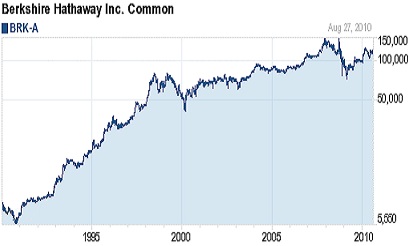
In his time, Warren Buffett has positively affected the lives of thousands of investors, including those who became wealthy employing his techniques (based on the work of Benjamin Graham), as well as those who simply bought his stock (BRK.A & BRK.B).


In addition to being a great investor, people connect with Buffett because he just doesn’t act like a typical billionaire. He is frequently spotted chatting with shareholders, enjoying T-bones at the local steakhouse, or playing bridge. Several years ago, a shareholder was surprised to see Buffett and his friend, Bill Gates, walking around a McDonalds restaurant in China, looking for a table.

In recent years, Buffett has developed an almost saintly reputation, which is not entirely accurate. He has always had a complicated social life that includes “female friends.” He unapologetically buys stocks of military hardware developers, tobacco companies and breweries if he considers them to be of good value. He takes advantage of the suffering of large companies (like all good value investors) by rescuing them in return for convertible preferred shares paying high rates of interest.

Despite his arguable flaws, however, most agree that his positive attributes - both personal and business - vastly outweigh them. While most billionaires are hated simply because they are billionaires, Warren Buffett’s likability and charm have actually grown with his riches.

Honesty and humility go a long way.

Rationality adds still more.
____


____

”Testing…one million, two million, three million.”

Warren Buffett, at the microphone of the University of Florida
____