Worldwide Business Search Engine

Loading

Friday, September 3, 2010

ETFMFs – Money Maker (but not for you)


Due to low fees and the ease of buying & selling, Exchange-Traded Funds (ETFs) have developed an excellent reputation amongst small investors. In fact, many people are cashing in their mutual funds to purchase ETFs through discount brokerages (such as E-Trade, TD Waterhouse etc.).

To compete, the mutual fund industry has retaliated with perhaps the most senseless investment product created in years – the Exchange-Traded Fund Mutual Fund.

Traditional Exchange-Traded Funds (ETFs) are similar to mutual funds. Each ETF is actually a “basket” of stocks, so by purchasing a single ETF you make a small investment in several companies. For example, if you buy stock symbol ZEO (A Canadian Oil and Gas Index Exchange-Traded Fund), you purchase a portfolio of common shares of Canadian oil and gas companies. ETFs are therefore a great way for the small investor to diversify.

There are 2 major things that make ETFs superior to mutual funds. 1) ETFs can be bought or sold at any point in the day, instantly, just like a stock. In contrast, mutual fund prices are determined only at the end of the day, and require 1-3 days for processing. 2) ETFs have lower management fees than mutual funds - sometimes much lower.

An Exchange-Traded Fund Mutual Fund (ETFMF) is basically a basket of ETFs, put together to form a mutual fund. That is, you take stocks from several companies and put them in a portfolio, then take several of these portfolios and put them in a portfolio, and the result is an “ETFMF.” With an ETFMF, you get all the disadvantages of a mutual fund with none of the benefits. You pay the high fees of a mutual fund, except now in multiple layers (since you pay the ETF fees, and then mutual fund fees on top). And, you cannot buy or sell them in the market like real ETFs, since they are actually mutual funds.

The reason ETFMFs were created, from what I can tell, is to satisfy naive customers who don’t really understand what an ETF is. Now, customers can ask a mutual fund salesperson, “Do you sell ETFs?” and the salesperson can answer “Yes.” Other than this, I see no benefit to them whatsoever.

If you want to buy a mutual fund that is similar to an ETF, buy an Index Mutual Fund, which is also a basket of companies and has low fees. If you want to buy an ETF, buy a real ETF. ETFMFs are a hybrid product that someone dreamed up in a back room, and have no place in your portfolio.
____

“It’s likely that some don’t even know that these fees are being deducted from their funds or who they are ultimately compensating.”

SEC Chairman Mary Schapiro, regarding mutual fund fees.
____

Tuesday, August 31, 2010

US Banks: What a Difference a Year Makes

Although recent financial news has a decidedly cataclysmic tone, evidence continues to mount that things are improving frustratingly slowly and steadily, exactly as expected.


Today, the FDIC announced that US banks earned, in aggregate, 21.6 billion dollars in the second quarter of this year (FDIC). Though this is still well below historical standards, what is striking is that most banks (80% of them) have returned to profitability.

Back in May, when I first publicly recommended bank stocks (US Banks), headlines warned that the government might force banks to be broken up and sold, that financial regulation could destroy them, and that a new debt crisis (ex. Greece) might soon cripple them. None of these things has materialized.

Since May the US financials index (XLF) has nonetheless dropped from $15.36 to $13.44, despite quantitative improvements in all areas of banking: decreased leverage, reduced loan loss provisions, increased profitability, improved credit market stability, and more.

The new worries for banks include a flattened yield curve (making credit spreads less profitable), a potential double-dip in housing, and that Barack Obama is secretly a communist Muslim and/or Biblical Anti-Christ whose intention is to destroy the US financial system.

If you truly believe that the US economy will never improve, and that US families will never again buy cars or houses, use credit cards or keep bank accounts, you should definitely stay away from bank stocks.

If you believe that banking has a future in America (and that America has a future at all), this year’s prices may well mark the single greatest buying opportunity we will see in our lifetimes.
____

"After 1929, so many people had been traumatized by the stock market crash that there was a lost generation."

Ron Chernow
____

Disclosure and Disclaimer

Do not buy stocks, or take this or any other financial advice without doing your own analysis; including, but not limited to: reviewing business models, financial statements, management style and philosophy, recent developments, market macroeconomic analysis, and chart analysis. If you do not know how to do these things, you shouldn't be buying stocks in the first place. Seek the advice of professionals, as appropriate.
____

Related amusement:

Monday, August 30, 2010

Happy Birthday, Warren


The richest man in America turns 80 today.

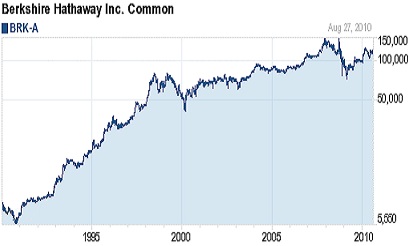
In his time, Warren Buffett has positively affected the lives of thousands of investors, including those who became wealthy employing his techniques (based on the work of Benjamin Graham), as well as those who simply bought his stock (BRK.A & BRK.B).


In addition to being a great investor, people connect with Buffett because he just doesn’t act like a typical billionaire. He is frequently spotted chatting with shareholders, enjoying T-bones at the local steakhouse, or playing bridge. Several years ago, a shareholder was surprised to see Buffett and his friend, Bill Gates, walking around a McDonalds restaurant in China, looking for a table.

In recent years, Buffett has developed an almost saintly reputation, which is not entirely accurate. He has always had a complicated social life that includes “female friends.” He unapologetically buys stocks of military hardware developers, tobacco companies and breweries if he considers them to be of good value. He takes advantage of the suffering of large companies (like all good value investors) by rescuing them in return for convertible preferred shares paying high rates of interest.

Despite his arguable flaws, however, most agree that his positive attributes - both personal and business - vastly outweigh them. While most billionaires are hated simply because they are billionaires, Warren Buffett’s likability and charm have actually grown with his riches.

Honesty and humility go a long way.

Rationality adds still more.
____


____

”Testing…one million, two million, three million.”

Warren Buffett, at the microphone of the University of Florida
____