
Worldwide Business Search Engine

Loading

Monday, August 30, 2010

Happy Birthday, Warren


The richest man in America turns 80 today.

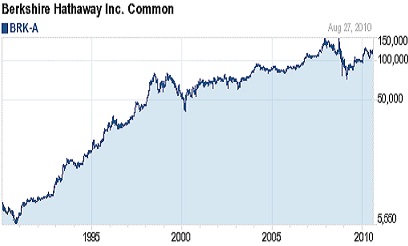
In his time, Warren Buffett has positively affected the lives of thousands of investors, including those who became wealthy employing his techniques (based on the work of Benjamin Graham), as well as those who simply bought his stock (BRK.A & BRK.B).


In addition to being a great investor, people connect with Buffett because he just doesn’t act like a typical billionaire. He is frequently spotted chatting with shareholders, enjoying T-bones at the local steakhouse, or playing bridge. Several years ago, a shareholder was surprised to see Buffett and his friend, Bill Gates, walking around a McDonalds restaurant in China, looking for a table.

In recent years, Buffett has developed an almost saintly reputation, which is not entirely accurate. He has always had a complicated social life that includes “female friends.” He unapologetically buys stocks of military hardware developers, tobacco companies and breweries if he considers them to be of good value. He takes advantage of the suffering of large companies (like all good value investors) by rescuing them in return for convertible preferred shares paying high rates of interest.

Despite his arguable flaws, however, most agree that his positive attributes - both personal and business - vastly outweigh them. While most billionaires are hated simply because they are billionaires, Warren Buffett’s likability and charm have actually grown with his riches.

Honesty and humility go a long way.

Rationality adds still more.
____


____

”Testing…one million, two million, three million.”

Warren Buffett, at the microphone of the University of Florida
____

Wednesday, August 25, 2010

Is the US Recovery in Danger?


This week saw low sales numbers in housing, lowered (but still rising) durable goods orders, and a generally pessimistic attitude all across the board.

In fact, “pessimistic” may be an understatement. One website effectively summarized the prevailing mood: “Things will never get better. We are all doomed.”

One of many problems with doom and gloom reporting is the resulting dialectical materialism (George Soros calls it “reflexivity”). When people believe something it can become a reality, even if it wasn’t a reality at the time people began to believe it. For example, if people believe there is an increasing chance they will lose their jobs or homes due to recession, they will curtail their spending, thereby causing the recession that they feared. Despite the reflexivity effect, however, I do not believe that this recovery is endangered.

Consumer “entrenchment mentality” is already in full force, and has been for some time. As noted earlier in The Frost Report (The Spending Zone), Americans have been paying off their debts and increasing their savings for seven months straight, and are almost at the point where their free cash flow will increase substantially. As a result of these debt repayments and savings, consumer credit scores are already the highest they have been since 1998.

The corporate world largely reflects the personal one: businesses have vast amounts of emergency cash, have paid down and/or refinanced debts, and have streamlined staff and operations. Corporate America is mean and hungry. With solid balance sheets and low stock prices, M&A activity should rise soon and remain high for months.

The combination of high cash flow, lower debts, higher savings, and excellent credit ratings simply does not match the “we are all doomed” mentality. Similar to cult members who wait for the mother ship, at some point people will realize that the economic apocalypse they are preparing for is simply not going to occur.

Based on the numbers, I suspect that this revelation will strike the US consumer within the next 3 quarters. Regular (if not exceptional) spending will resume shortly thereafter, and corporate America will follow suit with mergers, expansions and hiring.

Though the international picture is deteriorating, it will not be enough to derail the US turnaround.
____

“Hysteria has now disappeared from Wall Street.”

The Times of London, November 2, 1929
____

Monday, August 23, 2010

Canada’s Banking Albatross

And How to Benefit from it.


Deathly afraid to enter the stock market, Canadian retail investors are keeping their money in low-yielding GICs and bond funds - if they are investing at all. Mortgage and refinance business has collapsed. The self-employed have entrenched. Business is slow.

With mortgages newly dead and rigor mortis setting in on investing, there is nothing to sustain the currently high stock prices of Canadian banks. As an investor, what can you do to protect yourself, and perhaps make some money in the process? The Frost Report states the case in black and white.

First off, sell your Canadian bank stocks, as well as your Canadian dividend mutual funds (which usually contain 50% bank stocks). In order for stocks to drop, banks don’t need to have a disastrous quarter; they just need to have a quarter that is less spectacular than the last one.

Secondly, sell your Canadian REITs (Real Estate Investment/Income Trusts). There is no point holding on to REITs to generate income when you know that income from real estate will soon drop, and the price of REITs along with it.

Thirdly, buy distant at-the-money put options on Canadian banks, so that you can make a profit on the coming stock price decline. If you don’t know what an at-the-money put option is or how it works, completely ignore this piece of advice, for now is not the time to be learning.

Alternatively, you can buy Inverse financial ETFs, such as the Horizons BetaPro S&P/TSX Capped Financials Bear Plus ETF 2X, (symbol HFD). Again, if you just read this description and have no idea what any of it means, don’t even consider buying HFD. For those who understand, read the full prospectus.

Lastly, Canadians should start paying down debts and building cash reserves. While everyone else is experiencing a crisis, you can be comfortable. Cash gives you a sense of control & security, and, when things start to pick up again (which they always do), you can take advantage of the bargains that will be everywhere.

The Bank of Canada shot the albatross with its low interest rates months ago, and for a while the results looked good. Now, however, the storm is approaching. As with any other impending disaster, preparation is crucial.
____


Bank of Montreal reports Tuesday Aug 24th. Analysts expect third-quarter share profit of $1.21, up from $1.05.

Canadian Imperial Bank of Commerce reports Wednesday Aug 25th. Analysts expect third-quarter share profit of $1.53, up from $1.36.

Royal Bank of Canada reports Thursday Aug 26th. Analysts expect third-quarter share profit of $1.02, down from $1.21.
National Bank of Canada also reports Thursday Aug 26th. A third-quarter share profit of $1.52 is expected, down from $1.79.

____

Disclosure
Do not buy stocks, or take this or any other financial advice without doing your own analysis; including, but not limited to: reviewing business models, financial statements, management style and philosophy, recent developments, market macroeconomic analysis, and chart analysis. If you do not know how to do these things, you shouldn't be buying stocks in the first place. Seek the advice of professionals, as appropriate.
____

“Instead of the cross, the albatross / About my neck was hung”

The Rime of the Ancyent Marinere, Samuel Taylor Coleridge.
____