Worldwide Business Search Engine

Loading
Showing posts with label warren buffett. Show all posts

Friday, March 23, 2012

AIG gets its Pants Back On


There are some companies that the average investor simply will not touch; American International Group is one of them.  AIG is, after all, a poster-child for the excesses of the 2008 banking fiasco.  While America burned, AIG executives dressed in togas and had grand parties – literally!

At The Frost Report, however, we recognize that companies the public hates are often good bargains.  When the numbers make sense, we let bygones be bygones.

This Wednesday, AIG paid back the US Treasury an additional $1.5 billion in TARP money, eliminating the government’s preferred share stake.  Tim Massad, the Treasury department’s assistant secretary for financial stability, had this to say about the event: “In the dark days of the financial crisis, when commitments to AIG totaled $182 billion, few would have believed that we'd already be able to reduce that amount by more than 75 percent, or that we may be able to recover every single dollar invested in the company.”  And yet they have – ahead of schedule.

Consider these statistics: AIG has a book value of $55 per share, yet today’s closing price was only $28.27.  In what always strikes me as one of the wonders of Wall Street, you can literally buy $55 worth of goods for $28.27.  Of course, "book value" is useless if AIG is forced to have a fire sale on its goods and sell them for less than cost.  So, is the company profitable?

AIG had annual sales of over 64 billion dollars in 2011, with profit of $15 billion on 1.9 billion shares outstanding.  Return on equity also handily beat the market at 26%.

Like other companies in the pariah class, there is no big rush to buy AIG.  The government will be selling its stake for some time, and the stock will not likely jump until that selling pressure is over.  Having said that, the government has done a good job of letting other companies it owns (like Citi) rise steadily in value, selling them in a mellow and responsible manner.

____


"I would suggest the first thing that would make me feel a little bit better toward them [AIG executives] is if they'd follow the Japanese example and come before the American people and take that deep bow and say, I'm sorry, and then either do one of two things: resign or go commit suicide."

Senator Charles Grassley, 2009

____


Disclosure

Do not buy stocks, or take this or any other financial advice without doing your own analysis; including, but not limited to: reviewing business models, financial statements, management style and philosophy, recent developments, market macroeconomic analysis, and chart analysis. If you do not know how to do these things, you shouldn't be buying stocks in the first place. Seek the advice of professionals, as appropriate.

____

Friday, March 16, 2012

A Tale of Trading Woe


Last Friday, I was chatting on the phone with a friend of mine who is a talented and logical investor: one of the elite.  He and I often trade views on economic trends or discuss companies and stock tips, and this was just such a day.

He mentioned having recently bought a company called “Viterra,” which has a virtual monopoly on grain storage and shipping in central Canada.  He said that its price had dropped in recent quarters, and went through a short burst of statistics to back up his “great buy” claim, including earnings history, price to book value, and the nature of the industry.  I told him I’d check it out, and we each hung up the phone.

It only took a couple of minutes for me to realize that Viterra was indeed a great company at a great price, so I put in a limit order well above the current bid (at $11.50), to make sure I’d get in.  Then I hit the "enter" key and sat back.  But strangely, it didn’t fill.

I looked at my screen in disbelief as I read that trading had been halted pending an announcement.  The newswire then announced that “certain parties” had expressed interest in buying the company.  When the stock resumed trading a few minutes later, Viterra stock had jumped 29.8% to over $14 a share.  My order (at a now-measly $11.50) didn't fill.  Dammit!

Needless to say, my friend called back a couple of minutes later to casually jab me about my lost opportunity (“I didn’t know this would happen.  Honestly!”)

Shortly after that, I called him back to let him know that the transaction just made the cover story for the Globe and Mail’s online business section.

I completely missed out.


Lesson of the day: solid, undervalued companies do not stay that way forever.  Don't wait to buy.
____


“We didn’t lose the game; we just ran out of time.”

Vince Lombardi


____

Saturday, February 11, 2012

Share Buybacks - Good or Bad?


A recent article from Canada’s Globe and Mail ("Share Buybacks: The wrong way to reward shareholders") suggests that stock buybacks are - as a rule - useless.

The Globe article states that after a buyback program is announced a company's stock price usually declines anyway; that is, the buyback typically signifies a peak, and does not add any value to shareholders.  But is this correct?  How can buying back shares not add value to shareholders?

The Globe's simple look at the statistics ignores the rationale for doing buybacks. In fact, there are good stock buybacks and bad ones, and management’s reasoning makes all the difference.

Share buybacks can be the best way to reward shareholders. The fact that the market doesn't immediately recognize this and boost the stock price is irrelevant.

When a company's shares are trading at close to or below book value and at low P/Es, why would the company issue dividends or make acquisitions? Buying the stock of an underpriced company (their own) is the best choice. Every share bought back by the company means more earnings for remaining shareholders. For example, if a company has earnings per share of $.50 and you own 100 shares, your personal share of the earnings is $50.00. If the company buys back ¼ of its shares, your personal share of the same earnings is now $62.50. Eventually, more earnings per share = a higher stock price.

On the other hand, if a company's stock is overvalued either in terms of P/E or book value (or both),  then share buybacks are clearly a waste of money: why buy back overpriced shares when the same money could be used to make valuable acquisitions or pay a dividend? In this case, a share buyback doesn't make sense.

When management does a share buyback for the right reasons, people notice.  When Berkshire Hathaway, for example, announced in Sept of 2011 that it would buy back shares, BRK jumped 8% in a single day.

The Globe and Mail article notes that companies typically buy back stock when they are flush with cash but stock prices are high - which is the wrong time to buy back stock. At the moment, however, many companies are flush with cash at a time when their stock prices are low - the perfect time to buy back stock.

Good companies pay extra dividends or make acquisitions only when their stock is overvalued (or at least fairly valued).  When their stock is undervalued, buybacks are the best choice.
____

"When companies purchase their own stock [at a discount to fair value], they often find it easy to get $2 of present value for $1."

Warren Buffett
____

Sunday, January 22, 2012

Berkshire Hathaway's Machine


If you believe recent commentaries, Berkshire Hathaway’s Warren Buffett – once considered one of the greatest investors in the world – is now “too old” for investing and is washed up, tired, and has lost his touch.  The people making these comments have clearly not taken the time to examine Berkshire’s financial statements!

In investing, timing is everything.  An undervalued investment can sometimes take months or years to begin rising in price; and, while waiting, returns will be stagnant.  Berkshire has found a way around this problem.  Berkshire is now so synonymous with safety and stability (and for being a good business partner) that it obtains exclusive deals – unavailable to anyone else - where it is actually paid to wait.

Take, for example, Berkshire’s investment in Bank of America.  BAC’s current share price is $7.07.  Berkshire bought preferred shares of BAC that earn 6%.  With this preferred share deal came warrants to purchase up to 700 million shares of BAC at $7.14 per share, and these warrants don’t expire until 2021.  In other words, any time between now and 2021, Berkshire can purchase BAC shares at $7.14 per share, even if the stock doubles or triples (or more).  While waiting, Berkshire earns 6% on the Preferred shares!

Berkshire has a similar deal with Dow Corporation.  Berkshire currently earns 8.5% on Dow Preferred Shares.  Berkshire can purchase up to 72.6 million shares of Dow at $41.32 per share with no expiry date, except the stipulation that Dow has the option to redeem the preferred shares when the stock attains stable prices of $53.72 or more!  Put more simply, this means that Berkshire will earn 8.5% from its investment in Dow for months or years, and then make at least $12.40 per share ($52.72-$41.32) when the Preferred shares are converted to common shares, for an additional profit of 900 million dollars.

Berkshire Hathaway is an incredible moneymaking machine...especially for those who have the luxury of time, and the patience to wait.

____


"The most important attribute for success in value investing is patience, patience, and more patience.  The majority of investors do not possess this characteristic."

Peter Cundill

____

Tuesday, January 17, 2012

Stocks I Like - Leucadia National Corp


Leucadia National Corporation (stock symbol: LUK) may be the biggest, most successful company you've probably never heard of.

A quick look at Leucadia's website (www.leucadia.com) reveals that this company is different; the homepage looks like it was designed by a high-school student twenty years ago (and maybe it was).  One would never guess that as of Q3 2011, the company had assets in excess of 9 billion dollars, and that in 2010 - Leucadia's last fully reported year - the company had $1.3 billion in revenues.

Virtually everyone these days has heard of Berkshire Hathaway and it's famous value investor, Warren Buffett.  Yet, Leucadia National Corp. has managed to stay under the radar of the average investor: presumably where they want to be.

Like Berkshire Hathaway, Leucadia is a conglomerate, specializing in the purchase of undervalued, under priced assets.  Also like Berkshire, their annual reports are easy to read, honest and straightforward.  Unlike Berkshire, Leucadia loves to buy "turnarounds" - companies with bad management, shoddy business practices, or lack of funding.  It then sticks with these companies - often for years - providing the management expertise and funding required until the moment of fruition.

At present, Leucadia owns investment banks, mines, timber companies, plastics manufacturers, wineries, energy companies, hotels , auto retailers and natural gas drillers.  Leucadia also has a 50% stake in "Berkadia Commercial Mortgage Inc.," a  joint venture with Berkshire Hathaway.

Leucadia frequently carries a massive cash and stock portfolio: as of Q3 2011, $306 million in cash and $811 million in investments.  Due to this large stock portfolio (and the fact that Leucadia purposely invests in money-losing companies), the company's income tends to swing wildly; despite this, the company has averaged a stunning equity growth rate of 20.2% annually since 1978.

Knowing that Leucadia's investors are value investors, you can be fairly certain that their current investments are drastically undervalued.

Leucadia is currently trading at $25.45 per share.

____


"We quickly changed the name from Goober Drilling to Keen Energy Services."

Ian Cumming and Joseph Steinberg of Leucadia National Corp, regarding their 2009 purchase of Goober Drilling of Stillwater, Oklahoma.

____


Disclosure

Do not buy stocks, or take this or any other financial advice without doing your own analysis; including, but not limited to: reviewing business models, financial statements, management style and philosophy, recent developments, market macroeconomic analysis, and chart analysis. If you do not know how to do these things, you shouldn't be buying stocks in the first place. Seek the advice of professionals, as appropriate.

____


Tuesday, November 29, 2011

The S&P Bank Downgrade


Today, just a day after I wrote an article supporting the purchase of US banks (see below), Standard and Poor's downgraded several of America's largest financial institutions, including Citigroup, Goldman Sachs, Morgan Stanley and Wells Fargo.

At first I was taken aback by the move, and even - just for a minute - slightly concerned.  Standard and Poor's said it had changed its ratings system ("with new criteria") for banks, resulting in the sweeping downgrades.

I thought, "Standard and Poor's changed its rating system, and downgraded the US banks?  What if their ratings system is actually correct now?  That's not good."

Then I read that Standard and Poor's had actually upgraded its rating for the crappy China Construction Bank - an overextended lender in a grossly overpriced market.  My concerns melted away.

Generic formulas still can't rate risk.

____


"If merely looking up forward financial data would tell you what the future holds, the Forbes 400 [richest people list] would consist of librarians."

Warren Buffett

____


See also:
Forget Greece and Italy


____

Monday, November 28, 2011

Dick Bove's Apology


On CNBC this Monday, Nov. 28th, analyst Dick Bove apologized for the failure of his foremost recommendation of the year: US bank stocks.

The official apology ran like this: “I failed to understand that the fears in the market concerning banking were so great that the fundamental improvements in the economy, the industry, and companies like Bank of American and Citigroup would simply be ignored.”

In other words, Bove's "apology" consisted of telling investors that they are foolishly selling excellent stocks that are a great value, simply out of fear.  He didn't quite call them idiots, but pretty close.

The reason I mention all this is because I agree with him.

Back in March (US Banks to Rumble), and again in August (Buffett and the Beautiful Banks) and I'm sure a few times in between, The Frost Report has recommended buying US bank stocks.  But after a short-lived pop, bank stocks kept dropping.  And dropping some more.  And a bit more yet.  So what have I been doing?

Why, buying more bank stocks, of course!  Instead of trying to guess which particular bank will fare the best, I have been purchasing the KBW and XLF bank index funds.  Every time the market has a 2-4% correction I buy more, since each "correction" misprices them just a little bit more.

The view that bank stocks are a great bargain is clearly an unpopular one.  Every time someone recommends bank stocks (like Dick Bove), their article is overwhelmed with comments calling them a loser/screwball/dope/idiot, or ranting about bank bailouts and world domination.  Fortunately, my goal is to make money, not to make popular decisions.

Bank stocks will recover because they are highly profitable, and an economic necessity for which there is no replacement (contary to popular sentiment, credit unions are not equipped to handle large-scale multi-national banking).

____


____

See also:
Bill Miller vs Instant Gratification
Bank Debt is Near Record Low

____

Disclosure

Do not buy stocks, or take this or any other financial advice without doing your own analysis; including, but not limited to: reviewing business models, financial statements, management style and philosophy, recent developments, market macroeconomic analysis, and chart analysis. If you do not know how to do these things, you shouldn't be buying stocks in the first place. Seek the advice of professionals, as appropriate.

____

Sunday, November 20, 2011

Are Hedge Funds Safe?


Many people now regard hedge funds as an alternative to mutual funds.  Marketed as the “rich man’s mutual fund,” hedge funds are supposed to be safer than mutual funds but with higher returns.  Is it true?

In the past, most hedge funds hedged.  That is, hedge funds positioned themselves so that whether the markets went up or down, they would make small but consistent returns.  One strategy, for example, was to buy stocks, but also buy put options on those stocks in case the market dropped (put options go up in value if stocks drop).  The end result would be a slightly lower return than the general market in boom times, but also a small return in panic times – overall, a small return that is more reliable and steadier than the market.  But that is the past.

These days, virtually all hedge funds make money from extreme leverage – investing with borrowed money.  Using borrowed money and derivatives increases (not decreases) risk, which can lead to both spectacular gains and spectacular losses.

The average life span of a hedge fund is approximately 5 years.  By the five-year point, most hedge funds have either failed (lost most or all of their money), or closed down.

Hedge funds tend to fail most often within the first 30 months of their existence.  After 30 months they are less likely to fail, but more likely to shut down due to mediocre returns.  As a hedge fund investor, you are screwed either way.  If you invest in new hedge funds you risk losing everything; if you invest in an established fund you probably won’t get the returns you are looking for.  Some say that the way to avoid this minor inconvenience is to invest in a "fund of funds": a single fund composed of a number of hedge funds to reduce risk.

The expected annual return on a “fund of funds” is about 7-8% per year (a 9% return on the funds, minus 1-2% management fees), vastly lower than most investors imagine.  For comparison, a typical balanced mutual fund also returns between 7-8% per year.  Some longstanding balanced mutual funds - such as the Fidelity Balanced Fund, available since 1986 - have returned more than 9% annually.

In 2008, Protégé Partners bet Warren Buffett - the most famous investor of all - that hedge funds would outperform the S&P 500 over a 10-year period, as Buffet himself has done.  In the first year of the bet hedge funds vastly outperformed the S&P (dropping only 24% compared the market drop of 37%).  In the following two years the S&P outperformed the hedge funds.  Time will tell the final result.

If you are looking for safe and steady returns, my advice is to forget about hedge funds. Take the easier route: create a balanced portfolio or buy a balanced mutual fund consisting of about 30-40% quality bonds and 60-70% stocks – the time honored strategy for consistent returns with lowered volatility.

If your primary purpose is to show off that you are rich and have money to burn, invest in a hedge fund and tell all your friends.

If you are keen to risk everything to get rick quick, try poker.

____


"We conclude that hedge funds are far riskier and provide much lower returns than is commonly supposed."

Burton Malkiel and Atanu Saha

____


See also:
Hedge Funds: Risk and Return (the pdf presentation)

____

Thursday, November 17, 2011

Bill Miller vs. Instant Gratification


From 1991 to 2005, value investor Bill Miller headed one of the most successful investment funds in the world, beating the S&P 500 (“the market”) for 15 consecutive years.  On November 17 2011, however, Bill Miller stepped down as superstar manager for the fund he made famous.

It is said that Bill Miller has lost his touch.

During 2008 and 2009, Bill bought “horrible” companies like U.S. financials.  Many of these picks lost large amounts after his purchases (some up to ¾ of their value), and are still now languishing as losers.

Phil Pearlman said this of Bill Miller and of mutual funds in general: “Mutual funds remind me of AOL dial-up (Internet service): a dwindling collection of old people who don’t know better, contributing monthly to a comically inferior product.”

What many consider to be the new and superior product is the Hedge Fund.

Hedge Funds assets have grown dramatically, from just $38 billion in 1990 to more than $1600 billion in assets today.  Hedge funds are hip, cool, young, exciting, and promise to make you more money with less risk - even if they have higher fees (see the next Frost Report article for more about this).

In many ways, Bill Miller is the latest victim of a worldwide phenomenon – lack of patience and the desire to get rich quick.

The very word “investing” implies buying an undervalued company, then waiting for the company to improve and grow and the stock price to improve along with it.  Virtually no one does this anymore.  People want instant gratification.  They think that if a stock doesn’t rise in 6 months or a year (or, god forbid - that it drops even more), the stock pick must have been “wrong.”  Others believe that the market is so rigged against them there is no point investing at all.

For value investors of the world, the societal shift from value investing to stock trading and hedge fund purchasing is a blessing.  The fewer the number of people who believe in value investing (picking great, out of favor companies and holding them for years), the more successful the strategy is.

Bill Miller was ruined not because his value picks were bad, but because they didn’t bounce back fast enough to prove the quality of his convictions; and, his investors didn't have the patience to find out.

____


"The market does reflect the available information, as the professors tell us. But just as the funhouse mirrors don't always accurately reflect your weight, the markets don't always accurately reflect that information. Usually they are too pessimistic when it's bad, and too optimistic when it's good."

Bill Miller

____

Friday, October 28, 2011

How to Invest if you are Worried about Losing Money


These days, many are tired of the crazy gyrations of the stock market, and worried about losing their savings.  How do you invest your money and still sleep at night?

This article gives the most common options for investing hard earned but frightened dollars, ranked from worst to best.


5.  High-Interest Savings Accounts

Worried investors love the idea of savings accounts because they are guaranteed by the government (up to limits), because the money can be taken out anytime, and because you don’t have to make any future decisions – just leave the money there.  However, savings accounts always pay far less than the rate of inflation – usually 3% less.  For example, if the rate of your high-interest savings account is 1.5%, the inflation rate for the same period is probably 4.5%.  So, you are actually losing 3% of your purchasing power for every year you keep your money in the account.

If you invest $50,000 in a savings account and keep it there for 2 years, you appear to have $51,511.  But in fact, the purchasing power of your money is now worth only $47,045.

No one should leave money in a savings account unless it is for a few weeks or less.


4.  Guaranteed Mutual Funds

Guaranteed mutual funds are a relatively new concept.  You buy a mutual fund today that has a “maturity date” of, say, 10 years later.  As long as you hold the mutual fund until the maturity date, your principle is guaranteed!  Even if the market crashes you can’t lose your principle.  Sounds great, except that the issuer (typically a bank) can change the nature of the fund at any time.

Say, for example, you buy a guaranteed fund full of stocks and then the market drops.  The bank can remove all risk for itself by changing the holdings of the fund from stocks to safe but low-paying government bonds.  After the change, there is no hope for you to make any substantial amount of money.  You can hold this now ultra-safe fund for 10 years and get your principle back, or sell it and lose money.

In short, guaranteed funds tend to charge higher fees for their “protection, ” then screw their investors anyway.


3.  GICs

Guaranteed Investment Certificates are extremely popular because they pay more than savings accounts and feature two beautiful words – “guaranteed” and “investment.”  Some people love rate shopping for GICs, and pride themselves on getting the best rate.  Professionals consider people who buy GICs as long-term investments foolish.  That’s because GICs are designed to give rates close to the rate of inflation but not exceeding it (see option 1, Savings accounts).  So, the only thing that is guaranteed is that you will slowly lose money.

GICs are excellent for elderly clients who are unable or unwilling to understand any other type of investment.


2.  Index-Linked GICs

The best way to explain an index-linked GIC is to give an example.  Say you buy a 5-year S&P 500 index-linked GIC.  Over 5 years, the return of your GIC will be half that of the stock market, as measured by the S&P 500 (500 large US companies).   So, if the stock market goes up 25% in five years, you will get 12.5%.  If the stock market goes up 80%, you will get 40% and so on.  If the market drops, you will get your principle back.

Index-linked GICs are a great way to play the stock market for those who are too skittish to invest directly.


1.  Short-Term Bond Funds

When you buy a short-term bond fund, you are lending your money to large and reliable companies and the government, who in turn pay you interest.  Because the money is leant over a short period of time, there is little danger that a company’s fortunes will change, rendering them unable to pay you back.  And, because each bond fund holds so many companies, you don’t really need to worry even if a couple of companies do go bankrupt.  Since the bonds are short-term, you won’t lose money due to changes in interest rates (long-term bond prices go down when interest rates go up).   Finally (and importantly), short-term bond funds always beat the rate of inflation. 

For these reasons and more, short-term bond index funds are great investments.  Do not confuse short-term bond funds with more risky high-yield bond funds, long-term bond funds, or real estate bond funds.  Note that although short-term bond funds are very safe, they are not guaranteed by either the bank or the government – they are subject to the good credit of the companies in the fund.

Short-term bond funds include:
VCSH - Vanguard Short Corporate Bond Index ETF
SCPB - SPDR Barclays Capital Short Term Corporate Bond ETF
BSV – Vanguard Short-Term Bond ETF (mix of corporate and government)


So there you have it – five common ways to invest without losing your shirt, the final two of which I highly recommend.

Investing safely is a solid first step to investing, but far from the last.  To be a superior investor, you really shouldn’t be worried about money at all (something that is far easier said than done).  Ironically, the more worried you are about losing money, the more likely you are to do something silly and lose money.  For those who know they have not mastered their fear of loss, please note that I wrote a book specifically for the purpose: The Intelligent Investor’s Mind.  The link can be found at the top right of this page.

Good luck and happy investing!

____


"The first rule of investing is don't lose money; the second rule is don't forget Rule #1."

Warren Buffett

____

Saturday, August 27, 2011

Buffett and the Beautiful Banks


For months now, The Frost Report has been recommending the purchase of US bank stocks. For months now, US bank stocks have been dropping in price.

Earlier this week, Dick Bove of Rochdale Securities received a lot of heat after saying that people were “simply flipping out” about bank stocks, and that valuations were “ridiculous.” He pointed out, wisely, that although bank stock prices were falling, bonds prices were not.

Unlike stockholders, who tend to speculate, bondholders simply want the company to stay in business so they can collect interest and then get their money back. If a company is in danger of going bankrupt, bond prices drop. Yet, financial bond prices are holding steady, some even rising, showing that bondholders are not worried.

On Tuesday, billionaire Warren Buffett was at home taking a bath, thinking about how BofA was suffering confidence-wise and yet was solid financially. He called BofA and made them a win-win offer, and by Thursday morning (24 hours later) he owned 5 billion dollars worth of Bank of America, with warrants to purchase 700 million shares. When the news was released, BofA’s stock price rose 10% in a single day. Fortunately, I had loaded up on BofA stock just three days earlier, when it dropped after a string of rumor emails hit Wall Street claiming that the company was filing for bankruptcy.

US Banks are shouldered with large amounts of potential litigation (ie. they are being sued). They still own thousands of underwater mortgaged properties. Interest rate spreads are affecting bank profitability. Why would an investor with the stature of Warren Buffett be interested in buying bank stocks? Why would Berkshire Hathaway, Buffett’s company, be holding more than 40% of its total investments in the financial sector?

It’s simple. Great investors don’t care about rumors or fear, or whether the stock price is currently falling or rising – they just look at the facts. And, as a sound investment, the facts about banks are compelling. Bank of America is a perfect example:

Bank of America has a Mt. Everest balance sheet, with $140 billion in cash and more than twice that in securities. It actually has $13.86 in cash per share, yet the stock is trading at only $7.76. Put another way, for $7.76 you receive $13.86 in cash, $30 worth of securities, and a business that is gaining market share.

I have to admit, I have found the continuing drop in bank stocks to be both annoying (why are people still afraid?) and exciting (I can buy more!) at the same time.

Perhaps Buffett’s timely investment in Bank of America will finally make people see the light.


Update: On Monday Aug 29th, BofA announced it had successfully sold half of it's 10% stake in China Construction Bank, for a gross profit of 5.3 billion USD. A wise move if ever there was one.

____


"A public-opinion poll is no substitute for thought."

Warren Buffett

____

For more information, see:

Stock Market Flipping Out on US Banks

Buffett Bolsters Bank of America

BofA Sells Half of China Bank Stake, Raising $8 Billion

____


Thursday, August 11, 2011

Culling the Sheep - again


This week marked the single biggest wave of selling by retail investors ever recorded.

On Monday Aug 8th 2011 alone, Swiss bank UBS recorded retail outflows of 1.3 billion dollars! No wonder the markets crashed.

In The Intelligent Investor’s Mind, I speak about "myopic loss aversion" – the tendency for people with long-term goals (such as retirement) to focus on short-term events, especially the gyrations of the stock market. Myopia literally means “shortsightedness.” Such shortsightedness typically beds with "recency bias" – the tendency to think that the current situation (good or bad) will last forever. This week’s market activity shows just how strongly these cognitive errors can destroy people’s financial well-being: usually their own.

If you doubt the intensity of this week’s retail investor freakout, check out these choice quotes:

"Investing in U.S. Markets is DEAD....DEAD… and it is NOT COMING BACK!!"

"Yeah, it's different all right, as in it is ALL coming down."

"Their plan is to get rid of paper currency and go to digital currency so they can make you a slave."

"666, whatever you'd like to call it is coming."

Yet the market rollercoastered, showing that as much as retail investors were frantically selling, professionals and value investors were swooping in to pick up the spoils. Bloomberg reported that insider buying by S&P 500 company executives reached levels not seen since March 2009.

This week also revealed some great moments in calm and cool leadership. First was Barack Obama’s matter-of-fact speech regarding the S&P debt downgrade, where he basically said (I’m paraphrasing), “I didn’t need a downgrade by S&P to tell me that our government had a dysfunctional moment. We need to fix the way our government works.” The second was from Federal Reserve chairman Ben Bernanke, who said that he would keep interest rates low (which makes it easy for businesses to expand & develop), but other than that, the markets just need to grow up and get on with it. The final moment was an interview with Bank of America’s Jamie Dimon, who demonstrated the sensibility of long-term thinking (see video below). Interestingly, all of these great moments were regarded negatively by the public, who just wanted their leaders to DO SOMETHING!

As usual, the counterintuitive nature of the stock market is at work: those who are fearful of losing their money are losing their money; those who are unafraid of losing their money are making more.

____


"There is no comparison between fear and greed. Fear is instant, pervasive and intense. Greed is slower. Fear hits."

Warren Buffett, Aug. 11, 2011

____


Tuesday, April 26, 2011

US Home Prices Drop Again


But is that bad?

In a story on CNBC, Home Prices fall for 8th straight month, David Blitzer, chairman of the Index Committee at S&P Indices, is quoted as saying, "There is very little, if any, good news about housing. Prices continue to weaken, trends in sales and construction are disappointing." When I read the same statement, I thought it was good news. Why the difference?

Everyone uses mental models in their daily life - whether they are aware of it or not. A mental model is a way of thinking, usually learned from the culture one grows up in, but often changed by education. A clear example is that in the West, most people believe that the mind/soul and body are separate. University educated individuals tend to use the scientific method to discover things, rather than logic or meditation.

Fictional character Sherlock Holmes famously uses “deductive reasoning” to solve crimes. Deductive reasoning is eliminating anything that must be false in order to find the last remaining item, which must be the truth. It is said that Sherlock Holme's author, Sir Arthur Conan Doyle, learned this technique from his university medical professor, who used it to diagnose patients.

Warren Buffett’s business partner, Charlie Munger, commonly uses “inversion.” Inversion is looking at every problem from the opposite direction from the normal one: for example, instead of asking, “How can we improve customer service?” Munger might ask, “How can we have terrible customer service?” The opposite of that answer is the way to have great customer service.

In Iraq, US soldiers and politicians often become annoyed because the Iraqis do not think of the relationship between cause-and-effect the same way we do. That is, they view the relationship between cause and effect as weak. If Iraqis take a day off to play cricket instead of building a new water pipeline, they don’t necessarily see the connection to having no clean water later that month. This difference in thinking is so frustrating for American troops that there is a whole series of military intelligence "lessons learned" documents devoted to it.

Now to examine David Blitzer’s comment: "There is very little, if any, good news about housing. Prices continue to weaken, trends in sales and construction are disappointing." Under normal circumstances, this statement would be perfectly logical. In a normal economic cycle, all these things indicate a weakening economy. David is inferring that low sales, low construction, and falling prices are bad – the traditional economist’s view. But is it truly bad? Or is David using a “fossilized mental model” – one that is not relevant for the situation?

The US had a housing bubble: that means there were unrealistic prices, oversupply, and sales to people who were not qualified. The remedy for a housing recovery is therefore lower prices, no new construction (until excess inventory is gone), and low new home sales (since foreclosures will be sold first). In other words, today's statistical weakness is exactly what the housing market needs to recover. At this point, strength in any of these numbers would be negative.

The banks can only release foreclosures onto the market at the same rate as the market is ready to absorb them. Since the banks control the flow of this inventory, new home sales and price stats are meaningless: any increase in market strength will be met by the release of foreclosures to match.

Prices are low enough that when the housing market does return, it will do so with a roar. Just like the bubble on the upside, the longer US housing numbers stay weak the more sudden and dramatic the recovery will seem.

Several months ago, I wrote that it was a good time to buy US real estate. Since then, in most cities home prices have fallen by about 3%. I do not apologize for this imperfection.

No one knows exactly when the market will recover, yet one thing is certain – buying quality real estate at a time of low interest rates and low prices will never prove to be a bad investment. Don’t try to catch the exact bottom.

____

"Don't try to buy at the bottom and sell at the top. This can't be done - except by liars."

Bernard Baruch

____

Saturday, April 2, 2011

The Berkshire Soap Opera

Earlier this week, Warren Buffett’s Berkshire Hathaway issued a surprising press release: one of their longstanding top executives, David Sokol, had resigned.

Here’s the gist of the story… Warren Buffett and his partner Charlie Munger make all the major acquisition decisions for Berkshire Hathaway. Executive David Sokol recommended to Buffett a company called “Lubrizol,” mentioning at the time that he owned some shares of it himself. Buffett was not particularly impressed with the idea of acquiring Lubrizol. About a week later, David Sokol spoke with the CEO of Lubrizol, and based on that conversation spoke with Buffett again, further recommending it as a good purchase. As a result, Buffett changed his mind and purchased Lubrizol, sending its stock price soaring.


What David Sokol had neglected to point out was that when he said he owned, “some shares” of Lubrizol, he actually meant 10 million dollars’ worth (more than 96 thousand shares). In just one day after the Berkshire purchase announcement, Lubrizol stock jumped from $104.50 to $133.80, earning David Sokol a cool 2.8 million dollars.


Was what David Sokol did illegal? Probably not. Was it unethical? Somewhat. Was it honest and open? Not at all.


On July 26th, 2010, Buffett wrote a letter to all Berkshire Hathaway managers (including Sokol), saying that reputation and honesty are of paramount importance to Berkshire’s business. For example, Buffett wrote: “We must continue to measure every act against not only what is legal but also what we would be happy to have written about on the front page of a national newspaper in an article written by an unfriendly but intelligent reporter.” At the end of the letter, Buffett reminds everyone that “there’s plenty of money to be made in the center of the court. If it’s questionable whether some action is close to the line, just assume it is outside and forget it.” Clearly, Sokol didn’t think that any of this applied to him.


Does this mean that Berkshire’s internal controls are weak? Does it mean that you should sell Berkshire stock? Of course not. Berkshire’s internal controls remain amongst the best in the world.


David Sokol didn’t do anything explicitly illegal. But, he did play too close to the line – and he knows it.

____


“Somebody is doing something today at Berkshire that you and I would be unhappy about if we knew of it. That’s inevitable: We now employ more than 250,000 people and the chances of that number getting through the day without any bad behavior occurring is nil.”

Warren Buffett, July 2010

____


Berkshire’s press release regarding David Sokol’s resignation is available at:
David Sokol Press Release

Sunday, March 20, 2011

Buffett States the Obvious


Warren Buffett...perhaps the only person in the world who can make huge headlines by stating the obvious.

Today's headline on CNBC.com: "Berkshire Will Not Exercise Goldman Stocks Immediately." The story explains that Buffett will not exercise his Goldman Sachs warrants - even though he would make a profit by doing so - because....(wait for it) he thinks the stock is worth more than it is trading at!

Pardon me, but isn't that why most people buy stocks in the first place - because they believe they are worth more than they are paying for them? Am I missing something? The article goes on to say Buffett believes that over time, the stock market will go up. During the credit crisis in 2008, Buffett made headlines by saying that the economy will "eventually recover."

It's hard to say why Buffett makes headlines with these statements. Is it that trading has become so prevalent that no one believes in investing anymore? Or, is it because pessimism has grown to such an extent that any positive statement, no matter how obvious, is embraced with open arms?

Whatever the reason, Buffett continues to be a source of sensibility - and the obvious.

____


"Well, I just don't know. I don't know whether Cotton's going to go up."

Warren Buffett, 2011

____


For additional information, see Berkshire Will Not Exercise Goldman Stocks Immediately

_____

Wednesday, September 15, 2010

Mad About Taxes


The media and the public are divided and angry.

Some people, such as billionaire Warren Buffett, say that tax increases for the rich are “fair,” since the rich currently pay less tax than the poor. For others, any increase in taxes for the wealthy is an example of socialist government, and a disincentive for hard work.

The expiration of the Bush tax cuts has been called “the wrong move at the wrong time.” This expiration, combined with Obama’s proposed tax increases for those earning more than $200,000 per year has been dubbed the “small business killer.” Should we be worried?

When I worked as a lender, a consistent thing I noticed about small business owners is that they claim to have almost no income. A man could own a successful business, drive a Mercedes and take annual vacations to France, yet according to his company's financial statements be making $20,000 a year. This was normal.

For lenders, the financial statements of small business owners can be frustrating. Owners typically often write off so much (to avoid taxes) that it becomes difficult to approve their loans.

“Just show a little more income next year,” lenders often tell business owners.
“But then I will have to pay income tax," the owners counter. "You know I make lots of money. Can’t you just approve it?”

The proposed tax changes would raise taxes for individuals earning $200,000 per year, or families earning $250,000 per year, with lower taxes for those earning less: this is hardly a small business killer. A small business owner that shows an income of $200,000 per year would, in all likelihood, be earning at least 3 times that much - and there are simply not many small businesses pulling in that level of income.

Then there is the debate about lowering taxes for the middle class. Many members of the middle class themselves are opposed. Personally, I find this hilarious. One of my favorite things about the GOP is that they have actually convinced people earning less than $200K a year that tax cuts for the rich are good for the economy, but tax cuts for themselves are unnecessary. I love it! Gullibility knows no limits.

From an economic standpoint, lowering taxes for the nation’s middle class makes sense. The middle class tends to live “paycheck to paycheck,” spending almost everything they earn. Any decrease in taxes (increase in money to spend) would go directly into the local economy. High-income earners, on the other hand, tend to save more, or spend their money overseas. In terms of boosting the economy, a tax decrease for low- and medium-income earners gives far more bang for the buck.

Being that the US has a record deficit, somebody’s taxes need to increase. Increasing taxes for corporations is a bad idea, since unemployment is still far too high and corporations are the nations largest employers. Tax increases for the middle class is also a bad idea, since their spending levels (which constitute most of the US economy) are already low. The wealthy are the best choice for tax increases, because their personal spending levels will be least affected.

Tax cuts for the rich after the economy is rolling smoothly again – sure, why not? Everyone believes in the American dream. Everyone believes that someday, they too will earn more than $200,000 per year. And, they want to make sure tax levels are low when they get there.
____

“In 1790, the nation which had fought a revolution against taxation without representation discovered that some of its citizens weren't much happier about taxation with representation.”

President Lyndon B Johnson

Wednesday, September 8, 2010

Pessimism is Wonderful


At dinner parties, coffee shops, classrooms and churches, the common voice of America is focused on the same two topics: recession & unemployment.

I have personally never seen a collective outlook so hopeless and dejected, where being positive about anything is seen as foolish. In short, the opportunity to invest in stocks continues to be wonderful.

I have written ad nauseum about the fact that times of great pessimism are the best times to buy stocks. But, since people find this so counter intuitive, here is the reason expressed in simple numbers…

Stock prices are determined by two major factors – company earnings and popularity. Times of pessimism tend to follow some great crisis that hurts company earnings and creates walls of worry.

Worry causes people to pay less for what earnings companies have, as reflected in a low price-to-earnings (P/E) ratio. During times of prosperity, the average P/E ratio of the market might be over 20. During times of deep pessimism, the average P/E of the market might be in the single digits. For the patient investor, the effects of company earnings and market P/E over the course of the business cycle is profound.

Say, for example, that during a recession, manufacturer General Electric's earnings are $1.00 per share at a P/E of 15, giving it a stock price of $15.00. After a few years, as the economy improves, GE’s income returns to $2.00 per share (the same level as before the recession, assuming that the company doesn't grow at all). At the same time, newly optimistic citizens begin buying stocks again, and stock prices rise to an average P/E of 20. This means that GE will now be priced at $2 x 20 or $40. Since one business cycle takes from between 3-7 years, in seven years or less you could make a return of 267% (from $15.00 to $40). The stock market rewards patience well.

At present, company earnings are low, P/E ratios are low, and negativity is high - the perfect formula for value investing.
____

“The most common cause of low prices is pessimism - sometimes pervasive, sometimes specific to a company or industry. We want to do business in such an environment, not because we like pessimism but because we like the prices it produces. It's optimism that is the enemy of the rational buyer.”

Warren Buffett
____

Disclosure

Do not buy stocks, or take this or any other financial advice without doing your own analysis; including, but not limited to: reviewing business models, financial statements, management style and philosophy, recent developments, market macroeconomic analysis, and chart analysis. If you do not know how to do these things, you shouldn't be buying stocks in the first place. Seek the advice of professionals, as appropriate.
____

Monday, August 30, 2010

Happy Birthday, Warren


The richest man in America turns 80 today.

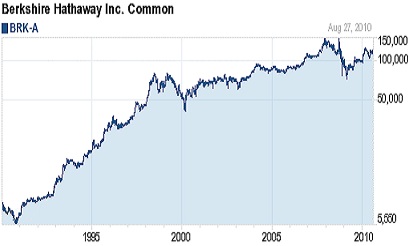
In his time, Warren Buffett has positively affected the lives of thousands of investors, including those who became wealthy employing his techniques (based on the work of Benjamin Graham), as well as those who simply bought his stock (BRK.A & BRK.B).


In addition to being a great investor, people connect with Buffett because he just doesn’t act like a typical billionaire. He is frequently spotted chatting with shareholders, enjoying T-bones at the local steakhouse, or playing bridge. Several years ago, a shareholder was surprised to see Buffett and his friend, Bill Gates, walking around a McDonalds restaurant in China, looking for a table.

In recent years, Buffett has developed an almost saintly reputation, which is not entirely accurate. He has always had a complicated social life that includes “female friends.” He unapologetically buys stocks of military hardware developers, tobacco companies and breweries if he considers them to be of good value. He takes advantage of the suffering of large companies (like all good value investors) by rescuing them in return for convertible preferred shares paying high rates of interest.

Despite his arguable flaws, however, most agree that his positive attributes - both personal and business - vastly outweigh them. While most billionaires are hated simply because they are billionaires, Warren Buffett’s likability and charm have actually grown with his riches.

Honesty and humility go a long way.

Rationality adds still more.
____


____

”Testing…one million, two million, three million.”

Warren Buffett, at the microphone of the University of Florida
____

Friday, July 2, 2010

Stocks I Like - Citigroup


Citigroup – the company that almost went bankrupt in the subprime credit crisis, that received billions of dollars in government aid, and whose management has been called inept – is on my buy list.

Collectively, mutual funds and other large retail investors cannot buy Citigroup, because their unit holders would go berserk with worry. After all, the news surrounding Citigroup has been nothing short of scandalous. This situation presents an opportunity for the astute investor. For those who invest using logic rather than emotion and who can think beyond the next quarter, the big “C” is a great buy.

First off, the price: $3.79 per share at last close. This puts Citigroup shares at well below book value. As I wrote at the end of May, “At the moment, you can buy $5.61 worth of Citibank assets for $3.81, and get all their clients, brand names, and worldwide businesses for free.” And what a franchise it is.

Outside of the US, I have used Citigroup banks in Delhi, London, Tokyo and Beijing. Citigroup is a global business powerhouse, and its image - though tarnished at home - is relatively unscathed elsewhere. Citigroup’s worldwide reach is enviable.

The price of C has been hovering at just under $4 for weeks, and will likely stay there until the US government finishes selling its ownership - 2.6 billion sold so far, with 5.1 billion more to go. So, there is certainly no rush to get in. However, once the government’s stake is gone, Citigroup’s price will likely move sharply upward.

In a couple of years, I would not be at all surprised to see Citi’s EPS rise to the $2+ range, which at a modest P/E of 10 would give the shares a price of $20. Nice.

____

"If a person is not willing to make a mistake, you're never going to do anything right."

Sandy Weill, former CEO of Citigroup
____

Disclosure
Do not buy stocks, or take this or any other financial advice without doing your own analysis; including, but not limited to: reviewing business models, financial statements, management style and philosophy, recent developments, market macroeconomic analysis, and chart analysis. If you do not know how to do these things, you shouldn't be buying stocks in the first place. Seek the advice of professionals, as appropriate.

Sunday, June 27, 2010

Barack Obama - Enemy of Business?

The same people who were clamouring for financial reform during the height of the crisis now appear to be taking a "if it's not broken don’t fix it" approach. Having seen their stocks go up since the lows of 2008, fear of change has taken hold. How can we be considering financial reform when talk of it makes markets drop? Don't the markets "know everything?"

Many conservatives have branded financial reform or regulation as "socialist" or "communist," making the ridiculous conclusion that since the highly-regulated communist structure didn't work, a complete lack of regulation must be best. Such short-term and narrow minded thinking is bad for the nation. Financial reform is necessary - and has been a long time coming:
__

"If we bail out this one (Penn Square Bank)...then the markets will know that, no matter what risks they take, the government will bail them out. Eventually, its going to lead down the road to nationalization of the banking system."

William Isaac, FDIC chairman, 1982
__

"If this sounds like a warning, it is."

Gerald Corrigan, President of the Federal Reserve Bank of New York, telling bankers that the over-the-counter (OTC) market seemed to be expanding without adequate controls, 1992
__

"Improved 'transparency' - a favorite remedy of politicians, commentators and financial regulators for averting future train wrecks – won't cure the problems that derivatives pose. I know of no reporting mechanism that would come close to describing and measuring the risks in a huge and complex portfolio of derivatives."

Warren Buffet, Berkshire Hathaway 2008 Annual Report
__

"A key question: Should we opt for even more pain now to gain a better future? For instance, should we create new controls to stamp out much sin and folly and thus dampen future booms? The answer is yes. Sensible reform cannot avoid causing significant pain, which is worth enduring to gain extra safety and more exemplary conduct."

Charles T. Munger, 2009, in the Washington Post
__

"A clear lesson of this crisis is that any strategy that relies on market discipline to compensate for weak regulation and then leaves it to the government to clean up the mess is a strategy for disaster."

Timothy Geithner, Secretary of the Treasury, 2010 in the Washington Post
__

"It is simply unacceptable to walk away from this recession without fixing the system's basic flaws that helped to create it."

Timothy Geithner, Secretary of the Treasury, 2010, in the Washington Post
__

"A clear lesson from the events of the past few years--and a recommendation in the report with which we strongly agree--is that the government must not be forced to choose between the unattractive alternatives of bailing out a systemically important firm or having it fail in a disorderly and disruptive manner. The government instead must have the tools to resolve a failing firm in a manner that preserves market discipline--by ensuring that shareholders and creditors incur losses and that culpable managers are replaced--while at the same time cushioning the broader financial system from the possibly destabilizing effects of the firm's collapse… The financial reform legislation in both the House and the Senate would provide for such a resolution regime."

Ben Bernanke, Chairman of the Federal Reserve, 2010, Fed Speech
__

In my estimation, one of the reasons people hate Obama is because he is forward thinking and logical, and therefore does things that voters hate (a rare combination in politics). In doing what's necessary, he successfully manages to piss off every possible segment of his support base. He makes poor people get health insurance coverage, even if they don't want it. He institutes financial reform at a time when the market is recovering and when each word from his mouth causes the market to drop. His logic, rather than his strict adherence to political philosophy, makes him "difficult" and "impossible to predict." Personally, I like the fact that Obama ignores popular opinion and just gets things done. No doubt he will be a one-term president.

Enemy of Business: no.
Enemy of dangerous, unregulated, pre-1929 style business: yes.
____

"Issues are never simple. One thing I'm proud of is that very rarely will you hear me simplify the issues."
Barack Obama